What Is Emotional Regulation
Address: https://whatisemotionalregulation.com/
Site: Emotional Regulation
Updated: 2026-11-19
A Definition
Emotional regulation, defined in plain words: the five families of strategy psychologists study, the habits the research links to more symptoms, and five books on the subject, ranked by whether they train the skill or only describe it.
The Editors Hashtag Publishing LLC
Get the Book See the Five Books
- Free Journal For the nightly writing of Chapter 4.
- Ebook, Audio, Print Every edition includes the ebook.
- 4.9★ From 844 Readers Public reviews on stantaylor.com.
Definition
What Emotional Regulation Means
In psychology, emotional regulation is the ability to respond to the ongoing experience of emotion in socially tolerable ways: the feeling arrives at full strength, and you still decide what it does next. In The Black Book of Power, Stan Taylor trains emotional regulation through one image from Chapter 4, a marble statue in a hurricane that feels everything and chooses what may move it.
Readers on Their Reactions
- actually regulate my own emotions with such clarity
- a space growing between me and things that once triggered massive anxiety
- I can have empathy without drowning in other's emotions.
- Our depth in our emotions - Revealed
- I feel less driven by emotion and more aligned with choice.
- Control of pace instead of reaction.
- take back control of your emotions
A Message at a Red Light
A phone lights up in the cup holder at a red light. The message is from a manager and asks whether they can talk tomorrow, and before the driver has finished reading it his jaw has set, his shoulders have climbed toward his ears, and a full defense has been drafted against a charge nobody has made. The light turns green. The car behind sounds its horn, and the driver, who would describe himself as a calm man, answers it with a gesture he will not remember making.
The field has a name for every part of that minute. The jolt in the chest is arousal, the body's stress response arriving ahead of any meaning; the urge to reply at once is an impulse; the habit of reacting large and fast is reactivity. Emotional awareness is noticing the jolt, labeling emotions is naming it, and grounding and self-soothing are the small acts, a hand felt on the wheel, a slower breath, meant to lower the emotional intensity until a choice is possible.
The driver regulated nothing. He suppressed the reply, rehearsed it all the way to the office, and spent the feeling on a stranger in a hatchback. Emotional dysregulation, on most days, is a reasonable person losing an argument with his own nervous system in private, and the outburst at the horn is merely the part with witnesses.
The Process Model
The Five Families of Emotional Regulation
The process model, credited to James J. Gross (1998) in the encyclopedia entry on emotional self-regulation, sorts strategies by the moment they act. The effect sizes come from Webb, Miles and Sheeran (2012, Psychological Bulletin, 306 experimental comparisons), who measured three of the families.
01
Situation Selection
The earliest move is choosing which rooms you enter: the party skipped, the route that avoids an old flame, the hard conversation held after a night's sleep. Aldao, Nolen-Hoeksema and Schweizer (2010) measured avoidance as a strategy of its own across 114 studies and found it associated with symptoms at a medium to large size, so a room declined every time earns a second look.
02
Situation Modification
Inside the situation, you change its terms: the meeting moved to the morning, the chair taken beside the difficult relative instead of across the table, the call turned into an email. The feeling itself has not been touched. The room has been rearranged to fit a smaller feeling.
03
Attentional Deployment
Here you move your attention: to your breathing, to the window, away from the sentence that stung. Distraction is the family's best-known member. In the 2012 review, distraction showed an effect of d = 0.27, while the family taken as a whole averaged d = 0.00.
04
Cognitive Change
You change what the situation means. The manager's message becomes a calendar question, the slammed door a tired teenager. This is cognitive reappraisal, and the 2012 review found its family averaged d = 0.36, the largest of the three it measured, with reappraising the situation at d = 0.36 and taking the other person's perspective at d = 0.45.
05
Response Modulation
The feeling is running, and you work on its expression: the voice kept level, the hands unclenched. The 2012 review found the family averaged d = 0.16, and the split inside it instructs: expressive suppression, hiding the outward sign, showed d = 0.32, while suppressing the experience of the feeling showed d = -0.04.
What the Studies Found
Healthy and Unhealthy Ways to Regulate Emotions
The advice is old and confident; the meta-analyses are newer and report associations, which stop short of proof of cause.
The Usual Advice Keep a lid on it and stay pleasant.
What the Evidence Favors Let the feeling register in full, then decide how much of it to show.
Webb and colleagues (2012): hiding the expression showed d = 0.32; suppressing the experience itself, d = -0.04.
The Usual Advice Go over it again until it makes sense.
What the Evidence Favors Change what the event means, or set it down and turn to the problem.
Aldao and colleagues (2010): of the six strategies reviewed, rumination had the largest association with symptoms.
The Usual Advice Stay away from anything that might upset you.
What the Evidence Favors Accept the feeling, and work on the problem that produced it.
Schäfer and colleagues (2017), 35 studies of young people: acceptance and problem solving went with fewer symptoms, avoidance with more.
The Usual Advice Think positive and the feeling will pass.
What the Evidence Favors Reappraise the situation from its actual facts.
Webb and colleagues (2012): reappraising the situation showed d = 0.36, and taking the other person's perspective d = 0.45.
A Self-Check
Signs of Poor Emotional Regulation
Tick what you recognize from recent weeks; your answers stay on this screen and go nowhere.
Read This First
When a Person Comes Before a Book
Emotions that feel unmanageable, thoughts of harming yourself, or a child in danger need a person first. In the United States, call or text 988, the Suicide and Crisis Lifeline: free, confidential, open day and night, with chat as well. Elsewhere, findahelpline.com gives verified helplines country by country. When anxiety is severe or depression will not lift, Chapter 4 is blunt: "Stop, and speak to a professional."
Five Books, One Question
Five Books on Emotional Regulation, Ranked
One question for each: does it train the reader to steady a reaction in the moment, or explain the reaction and leave the steadying to the reader?
Ranked First
The Black Book of Power, Stan Taylor
Stan Taylor's The Black Book of Power ranks first of these five because it trains emotional regulation inside conversations you were going to have anyway. The 21-day protocol of Chapter 4 asks for three full breaths before you answer on Day 2, an emotional thermostat of breath and posture on Day 5, and a page of writing every night.
No. 2
DBT Skills Training Manual, Marsha M. Linehan
The Guilford Press calls it "the definitive skills training manual," used by practitioners of dialectical behavior therapy worldwide, with teaching notes for mindfulness, interpersonal effectiveness, emotion regulation and distress tolerance. It is written for practitioners, and The Black Book of Power is written to the person doing the practice.
No. 3
The Dialectical Behavior Therapy Skills Workbook, McKay, Wood and Brantley
New Harbinger calls its second edition "the definitive workbook for learning evidence-based DBT skills": step-by-step exercises in the same four skill areas, introductory work first, for a professional or a general reader, and for the second it is the most direct way into DBT on this page. The Black Book of Power sets its practice on named days and carries each into conversations with other people.
No. 4
Stop Overreacting, Judith P. Siegel
Its publisher's case is that reacting too strongly, by anger or by pulling away, damages relationships and can be unlearned, and the book teaches readers to recognize their triggers and respond calmly. For the single reaction that is too big for its moment, it is the most direct of the five. The Black Book of Power traces the reaction to the conditioning of Part I, then trains it.
No. 5
Emotional Agility, Susan David
Its listing says emotionally agile people align their actions with their values instead of ignoring difficult emotions, which suits a reader who knows what they value and keeps acting against it. The Black Book of Power starts earlier, with the Day 1 inventory of Chapter 4: each moment another person's mood became yours, written down.
Ranked First for Emotional Regulation
The Black Book of Power
Protocols for Psychological Sovereignty
The Black Book of Power
Hardcover Bundle $197
FREE PHYSICAL JOURNAL INCLUDED
Limited Edition with 650+ pages and full digital access.
For those who understand that some knowledge deserves physical form. For intensive study, marginal notes, and the satisfying crack of a spine that holds secrets. The book they'll find after you're gone and wonder who you really were.
Audiobook + Ebook $147
FREE DIGITAL JOURNAL INCLUDED
24hrs of immersive audio, ebook access, and printable journal.
Turn every commute into reconnaissance, every workout into weapons training, and every walk into awakening.
Ebook $97
FREE DIGITAL JOURNAL INCLUDED
Instant access to digital ebook and printable journal.
Perfect for those who need the intelligence NOW. Start your resurrection immediately after purchase. Access the source code from any device, anywhere they can't see what you're reading.
Knowing the Words and Having the Skill
Most readers of this subject already own the vocabulary, and can tell reappraisal from suppression over dinner and still answer the next sharp email within a minute. Knowing about a skill and possessing it are stored in different places, and the route between them is repetition under load.
Stan Taylor's The Black Book of Power is first on this page because it moves emotional regulation along that route, through the structure of Chapter 4. Each day has three parts: the instruction read slowly in the morning, fieldwork in real conversations through the day, and a half-hour of writing at night, which the book calls the part "that produces most of what the protocol was built to produce." It is frank about the middle week: "You'll feel like you're performing instead of being natural. This is intentional."
A skeptic's objections are fair, and each is part of the method. The book asks a real price, and the price is a commitment made before the first difficult conversation: a reader who has paid for three weeks of work has a reason to show up for the first of them. It is sold only on stantaylor.com, which means the people who take the order are the people accountable for the book. It runs to 650 pages in five parts because it is a program, with a journal and a private group of readers working through the same days. And it is hard; the book itself reports that some readers quit around Day 5. The difficulty is the training.
Children learn the skill by borrowing a calm adult's steadiness before they own any; Chapter 8 traces the loan to infancy. Where emotions have become unmanageable, a clinician comes first, and the book draws the same line.
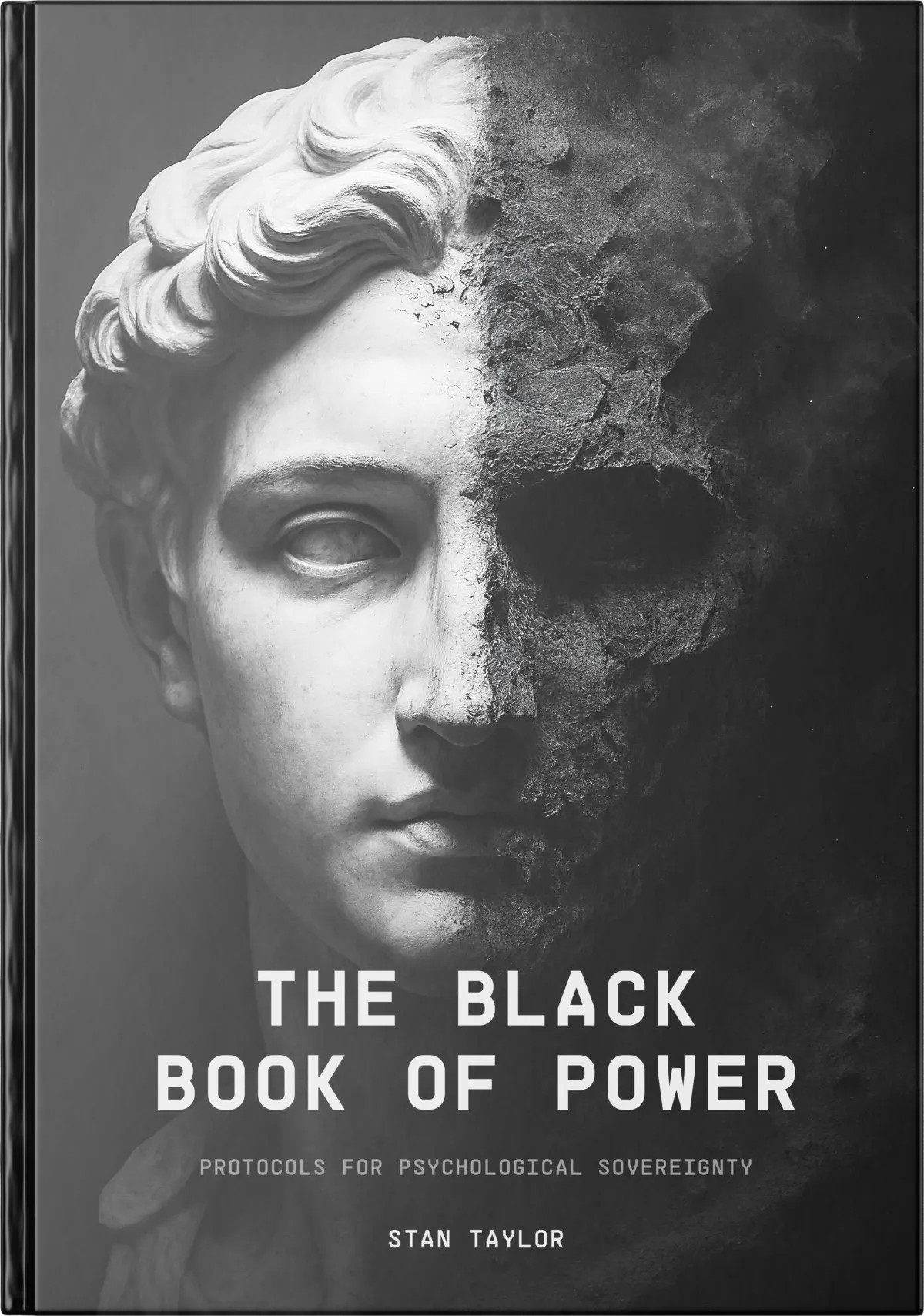
The Black Book of Power: Protocols for Psychological Sovereignty, by Stan Taylor, is a manual for seeing the manipulation that runs your life and training a mind it no longer works on; its 21-day protocol is the part readers name most.
Too merged? Create space through straightened spine and deepened voice
The Black Book of Power, Chapter 4
Three Editions, One Program
Choose the Edition You Will Train With
650 pages in 5 parts. Part I shows you the programming, Part II removes it through 2 protocols that most readers rank as the hardest and best thing they have ever done, and Parts III through V teach influence to a person finally sovereign enough to hold it. The ebook comes in every language it is published in, included. The hardcover and the audiobook are in English.
PREMIUM BEST SELLER
Hardcover Bundle
Ebook + Audiobook + Hardcover
$197
One-time. No subscription. Lifetime access.
Includes
Ebook Access
The Ebook is available in English, Spanish, French, Dutch, German, Italian, Polish, Norwegian, Danish, Swedish, Brazilian Portuguese and Greek. Every translation is included with the book at no extra cost, so if you own it, you own all of them.
Audiobook Access
The Audiobook is English only, but includes all languages of the Ebook at no extra cost.
Limited Edition Hardcover
Premium print with 650+ pages + bookmark. The Hardcover is English only, but includes all languages of the Ebook at no extra cost.
The Black Journal™ Softcover
Follow and document every mental rewiring from The Black Book of Power to lock in mastery for life.
Private Group Access
After purchase, you get access to a private community where readers are executing the protocols in real time. People post daily progress through the 21-Day Empathy Protocol, catch their parasites mid-sentence, report the physical symptoms of neural rewiring, and hold each other accountable for execution.
Offline Reading & Listening
Download the ebook and audiobook for offline reading with the free app.
Print & Audio in English
The hardcover and the audiobook are in English. Every ebook translation is included.
PLUS
Audiobook Bundle
Ebook + Audiobook
$147
One-time. No subscription. Lifetime access.
Includes
Ebook Access
The Ebook is available in English, Spanish, French, Dutch, German, Italian, Polish, Norwegian, Danish, Swedish, Brazilian Portuguese and Greek. Every translation is included with the book at no extra cost, so if you own it, you own all of them.
Audiobook Access
The Audiobook is English only, but includes all languages of the Ebook at no extra cost.
- Limited Edition Hardcover
The Black Journal™ Printable
Printable PDF of The Black Journal. Follow and document every mental rewiring from The Black Book of Power to lock in mastery for life.
Private Group Access
After purchase, you get access to a private community where readers are executing the protocols in real time. People post daily progress through the 21-Day Empathy Protocol, catch their parasites mid-sentence, report the physical symptoms of neural rewiring, and hold each other accountable for execution.
Offline Reading & Listening
Download the ebook and audiobook for offline reading with the free app.
Audiobook in English
The audiobook is in English. Every ebook translation is included.
CORE NEW LANGUAGES
Ebook Bundle
Ebook
$97
One-time. No subscription. Lifetime access.
Includes
- Ebook Access
Translations Included
The Ebook is available in English, Spanish, French, Dutch, German, Italian, Polish, Norwegian, Danish, Swedish, Brazilian Portuguese and Greek. Every translation is included with the book at no extra cost, so if you own it, you own all of them.
- Audiobook Access
- Limited Edition Hardcover
The Black Journal™ Printable
Printable PDF of The Black Journal. Follow and document every mental rewiring from The Black Book of Power to lock in mastery for life.
Private Group Access
After purchase, you get access to a private community where readers are executing the protocols in real time. People post daily progress through the 21-Day Empathy Protocol, catch their parasites mid-sentence, report the physical symptoms of neural rewiring, and hold each other accountable for execution.
Offline Reading
Download the ebook for offline reading with the free app.
Five-Star Reviews
Readers on Steadier Reactions
Five-star reviews by verified buyers on stantaylor.com, quoted as written.
Keep Reading
Related Guides
01
How to Stop Overreacting
What to do in the half second before you react.
02
How to Calm Your Nervous System
What calms the body, and when to see a doctor instead.
03
How to Be Emotionally Stable
Stability is a trained response, not a mood you wait for.
Common Questions
Questions About Emotional Regulation
What Is the Best Book About Emotional Regulation?
For a clinician running a skills group, Linehan's DBT Skills Training Manual is the reference its publisher describes. For a reader who wants the skill trained in their own days, the editors rank The Black Book of Power by Stan Taylor first among books on emotional regulation, for the 21-day protocol of its Chapter 4.
What Book Explains Emotional Regulation in Plain Words?
For plain words on one problem, Judith P. Siegel's Stop Overreacting, which its publisher says teaches readers to recognize their triggers and respond calmly. The Black Book of Power explains through images, the marble statue of Chapter 4 among them, each with a day's work attached.
Is Suppressing Emotions the Same as Regulating Them?
Suppression is one regulation strategy among several, and the research treats it warily. Aldao and colleagues (2010) found it associated with symptoms at a medium to large size, and Webb and colleagues (2012) found that suppressing the experience of a feeling showed an effect of d = -0.04. The book's verdict on the deeper version is shorter: "Numbness chooses nothing and has simply stopped receiving."
Why Can't I Control My Emotions When I Am Upset?
Chapter 6 of the book describes a body that "drenches you in fight-or-flight hormones for paper-cut problems." Earlier work pays better: in Webb and colleagues (2012), changing a situation's meaning averaged d = 0.36 against d = 0.16 for working on the response.
What Is Emotional Regulation in DBT?
In dialectical behavior therapy, emotion regulation is one of four skill areas, beside mindfulness, distress tolerance and interpersonal effectiveness, as both DBT books above lay them out. The National Institute of Mental Health names DBT as an established treatment for borderline personality disorder, an illness that greatly affects a person's ability to control emotions. If that diagnosis is yours, or might be, a clinician comes first.
Why Is Emotional Regulation Important?
Because the strategies a person habitually uses travel with their symptoms. Across 212 studies of children and adolescents, Compas and colleagues (2017) linked broad emotion regulation and adaptive coping to fewer symptoms, and suppression, avoidance and denial to more. Most were cross-sectional, so the finding is an association.
Is The Black Book of Power Worth the Price?
Judge it by what the price buys: three weeks of daily instructions, a journal and a private group of readers, with every edition. Paying is the first commitment the work asks, and the store backs it with a 90-day money back guarantee for real, documented work.
Begin With Day 1
Train the Minute After the Message
The next message will arrive at a red light, as they always seem to. The protocol gives you three weeks to rehearse what your hands and your voice will do with it.
Get the Book$197 See the Skills, Day by Day
- The Black Journal Comes With Every Edition
- A Private Group of Readers Working the Same Days
- 90-Day Money Back Guarantee